
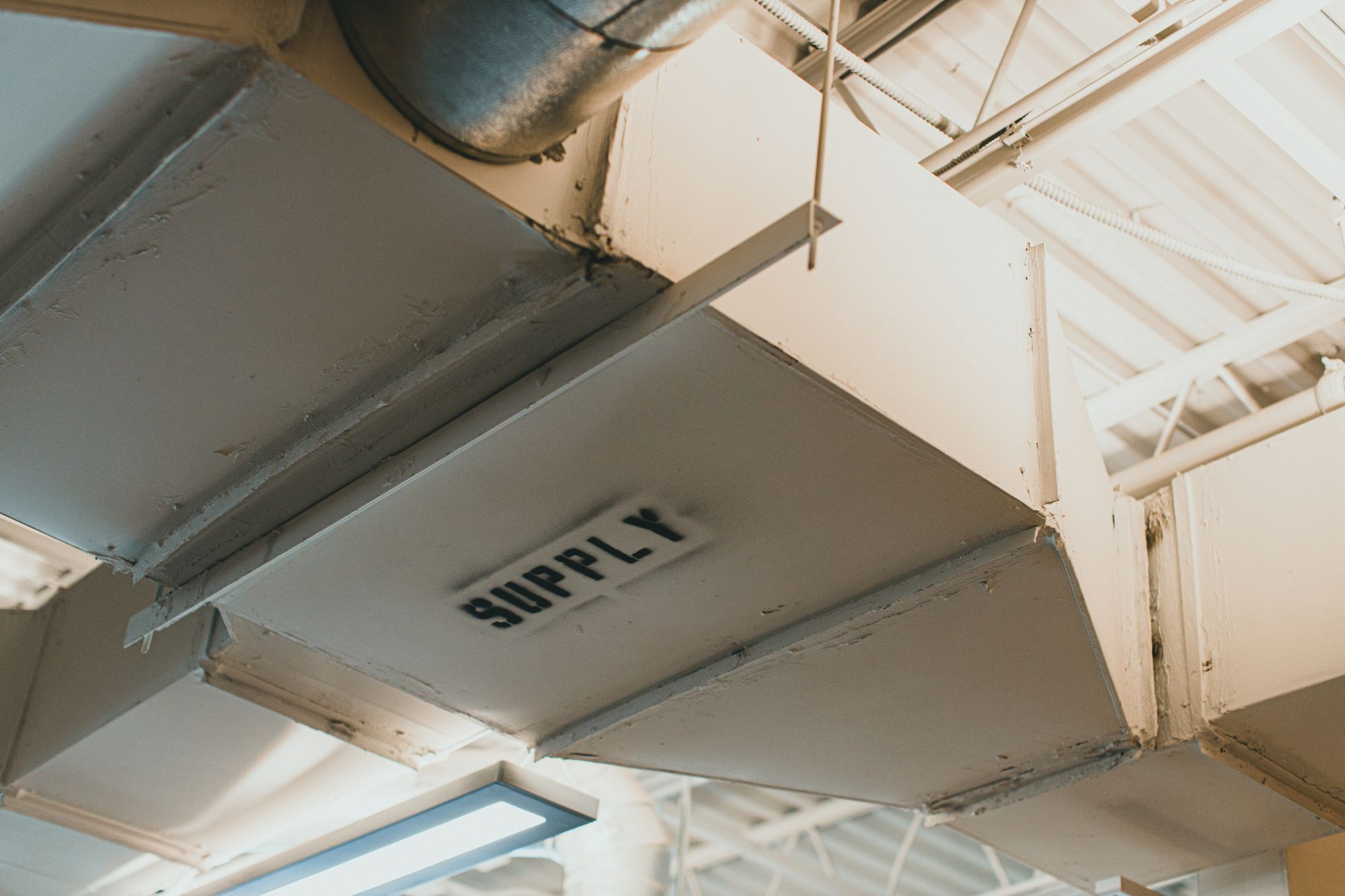
We get the call regularly: “we’ve got condensation, what do we need — MVHR or PIV?” The honest answer is that those two acronyms describe completely different ventilation strategies that solve overlapping problems. Picking the wrong one means spending two or three times what you needed to, or installing something that won’t fix what you wanted it to fix. This guide is the side-by-side we wish more homeowners had read before booking surveys.
1. What MVHR actually does
MVHR (Mechanical Ventilation with Heat Recovery) is a balanced ducted system. A central unit, usually in a loft or utility cupboard, has two fans and a heat-exchanger core. One fan extracts stale humid air from bathrooms, kitchens and en-suites. The other supplies filtered fresh air to bedrooms, living rooms and studies. The two airstreams pass through the heat-exchanger but never mix — the outgoing stream warms the incoming stream by conduction, recovering 85–92% of the heat that would otherwise be lost.
Typical kit:
- Unit: Vent-Axia Sentinel Kinetic, Zehnder ComfoAir Q450, Brink Renovent, Aereco DXR
- Ductwork: 75 mm or 90 mm semi-rigid Polypipe Domus or similar, run through ceiling voids
- Valves: ceiling-mounted supply/extract grilles in every habitable room and wet area
- Commissioning: air-flow balanced at each terminal, recorded in a commissioning report
2. What PIV actually does
PIV (Positive Input Ventilation) is much simpler. A single fan unit, usually mounted on the loft ceiling of the upstairs landing, takes air from the loft (which has been warmed by the house below in winter) and gently pushes it down into the house. The house slightly pressurises — air leaks out through every gap in the building envelope, taking moisture with it. No extract fans, no ductwork to wet rooms, no heat exchanger.
Typical kit:
- Unit: Nuaire Drimaster Eco Heat, EnviroVent ATMOS, Vent-Axia Pure Air Home
- Optional: low-wattage heater in the unit to temper supply on the coldest days
- Install time: 2–4 hours
3. Install cost comparison
The cost gap is the headline difference:
- PIV (3-bed home): £600–£1,200 fitted
- MVHR (3-bed home, retrofit): £3,500–£6,500 fitted
- MVHR (3-bed new build, first-fix): £3,000–£4,500 fitted
The cost driver for MVHR is ductwork. Running 75 mm semi-rigid through ceiling voids on a retrofit means lifting boards, fishing through joists, sometimes dropping ceilings. On a new build it’s straightforward because the first-fix happens before plasterboard goes up.
4. Running cost comparison
Both run at low power:
- PIV: typical fan power 6–15 W — about £15–£30/year electricity. Tempered models add 100–300 W when the heater is active, mostly overnight in deep winter.
- MVHR: 30–60 W combined fan power. About £65–£130/year electricity. Saves 15–25% on heating by recovering exhaust heat — for a typical Kent home, £150–£300/year.
Net for MVHR: £50–£200 saving against electricity cost, plus a quality-of-air benefit that’s hard to price. For PIV: small electricity cost, big condensation reduction benefit, no heating-bill saving.
5. When PIV is the right answer
PIV is the right call for:
- Older Kent housing stock with chronic upstairs condensation, especially in north-facing bedrooms
- Properties where ductwork is impractical (Victorian terraces, period flats, multi-storey conversions)
- Landlords needing to fix a damp problem on a tenanted property without months of disruption
- Owners on a budget where the choice is realistically “PIV or nothing”
6. When MVHR is the right answer
MVHR is the right call for:
- New builds — Part F essentially requires it for airtight construction
- Deep retrofits where insulation and airtightness are being upgraded
- Owners installing or planning to install a heat pump (MVHR + heat pump is a strong combination)
- Owners with allergies or asthma — MVHR’s F7 filter removes pollen and most particulates
- Properties with no chimney or trickle-vent provision and a modern airtight build standard
7. Common installer mistakes — and how to spot them
MVHR especially is easy to install badly. Things we’ve been called in to fix:
- Uninsulated ducts in cold loft spaces — condensation forms in the duct, drips, eventually drops the ceiling. All MVHR duct in unconditioned space must be insulated.
- Cross-talking between rooms — not enough acoustic attenuation in the duct runs. Bedrooms hear the kitchen.
- Unbalanced commissioning — without a proper anemometer-based balance, supply and extract drift, recovery efficiency tanks.
- Filters never changed — needs annual minimum, six-monthly in pollen-heavy locations like rural Kent.
8. How we approach the survey
The first thing we work out is what problem the homeowner is actually trying to solve. The answers cluster around four:
- Condensation on windows or in corners — bedrooms and bathrooms
- Mould around windows, behind wardrobes, on cold north-facing walls
- Air-quality / hayfever / asthma concerns
- Building Regulations compliance for a planned extension or refurb
Problems 1 and 2 are almost always solvable with PIV at a quarter of the MVHR cost. Problems 3 and 4 push toward MVHR. We say so straight, even when MVHR is the more expensive (and to us, more lucrative) install.
Genuinely the most common outcome on a Kent retrofit survey: PIV upstairs, plus a decent bathroom extract fan replacement, plus a new kitchen extractor hood properly ducted to outside. Total £1,200–£1,800. Solves the condensation and the smell complaints; saves several thousand against an MVHR retrofit that wouldn’t have performed well in a leaky 1930s semi anyway.